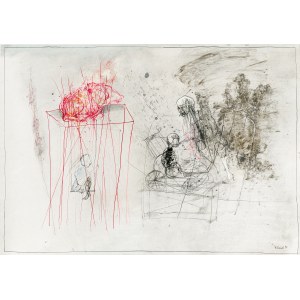
Signed and dated p. d.: H. Cześnik 90 [in pen];
On the back a sticker with an export stamp.
Painter originally from Sopot. Graduated from the State Higher School of Fine Arts under Kazimierz Ostrowski in 1977. Since 1987 he has worked at his alma mater, where he was awarded the title of full professor in 2003. As a didactician, he gives students the freedom to search for artistic expression, encouraging them not to abandon traditional painting. In his pedagogical work, he makes sure that young artists understand what they are doing and what art they want to do, whether it takes a performative or traditional form. As Henryk Cześnik recalls, Kazimierz Ostrowski behaved similarly towards him and other students.
This artistic openness of the painter manifests itself in his painting and drawing - two fields in this case closely intertwined, as in both genres the impressionistic line is dominant in the composition. Another characteristic feature of Henryk Cześnik's works is a kind of suspension in time. His compositions, especially some of his drawings, could have been created either in the painter's early youth or barely a few years ago, and likewise the subjects in them, which, if the space-time continuum were expanded further, could have just happened or been imagined by the painter. This leads Henryk Czesnik to create art on impulse, which at the same time bears the features of a kind of automatism in the execution of the work. Automatism understood as an unbridled need to create under the influence of external stimuli finding vent in the work.
Due to the potential lack of chronology, a line leads the viewer through Henryk Cześnik's work. The artist's canvases feature likely childhood figures, hospital beds, sisters taking care of the crippled, but also quotes from European painting. One should consider whether it is right to attribute to the painter, for example, childhood trauma under the influence of which he creates, or whether these are merely reminiscences and loose memories or imaginings. The same is true of attempts to read the artist's works. The suggestions that appear oscillate between surrealism, a macabre vision of the world, and neo-expressionism laced with black humor or the grotesque.